
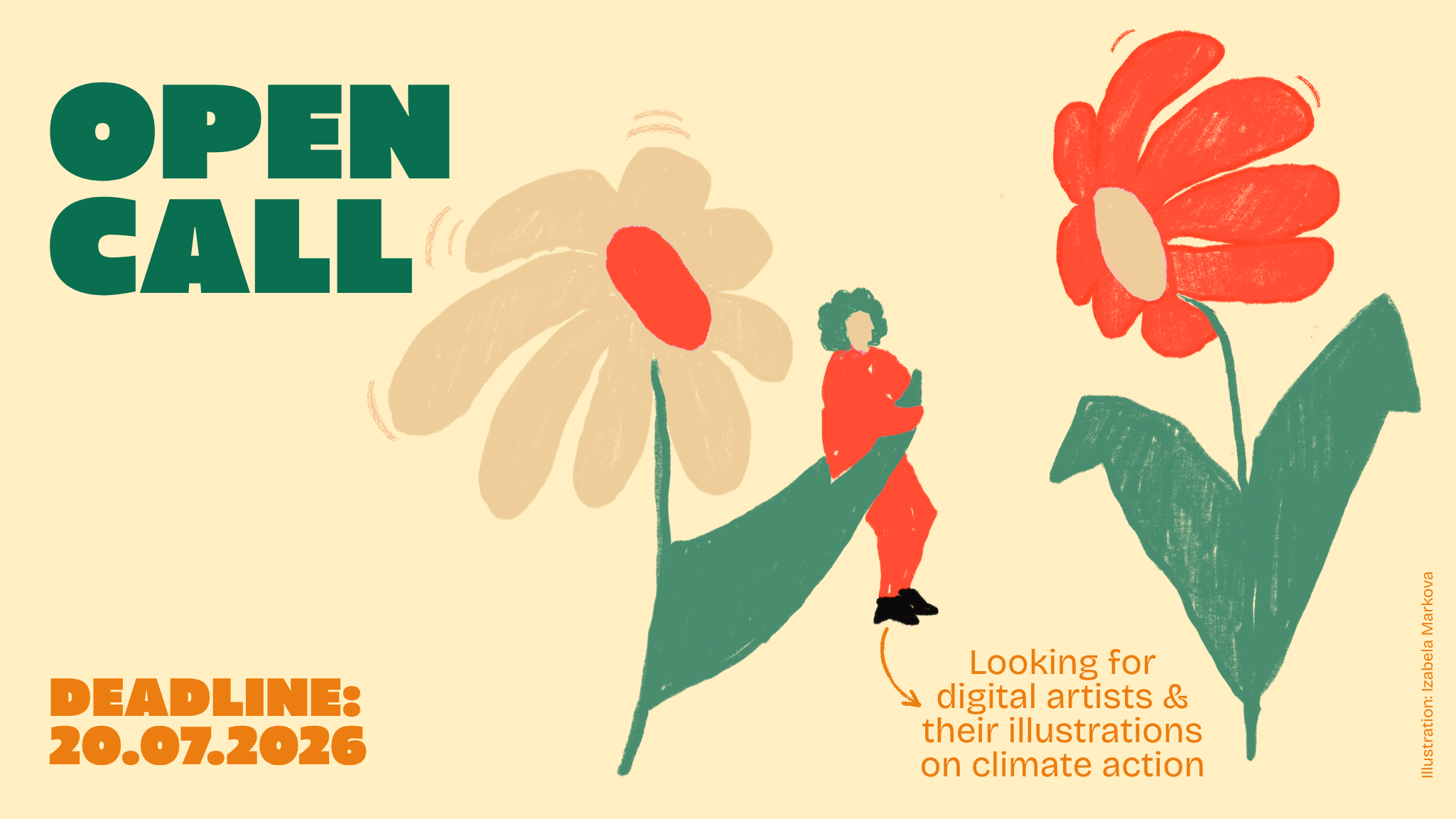
Hey, illustrators!
Join the Open Call
by July 20
Fine Acts, in partnership with DE/MO Foundation and Hafnar.haus, is launching an open call for digital illustrations on the theme of climate resilience and action.
We are looking for existing illustrations that help shift the conversation around climate change – from anxiety and apathy to hope, participation, and resilience. We seek visual works that inspire collective action, highlight community responses to climate challenges, and imagine positive pathways toward a more sustainable future.
We will select 20 illustrations to be published under an open license, allowing nonprofits, activists, educators, and changemakers to use them in their communications and campaigns (strictly for non-commercial purposes).
Our goal is to build a unique collection of visuals that support storytelling, advocacy, and public engagement around climate resilience and action, while making high-quality socially engaged artwork freely accessible to those working for positive change.
If you are an artist from the Creative EU countries (see the full list of eligible countries in the ‘selection criteria’ part below), submit your illustration by JULY 20.
You do not need to create a new work for this call, but you must present only work that you own the copyright to and that is not subject to exclusive rights. If your illustration is selected, you will receive a €200 licensing fee and your work will be published under an open license on TheGreats.co, the largest global platform for free socially engaged art (run by Fine Acts). If selected, you will retain ownership of your work and remain free to sell it or use it for commercial purposes.
To submit your work for consideration, simply fill in the application form below.
-
The project
This open call is part of CARE – a cross-European initiative built on the belief that arts and culture play a vital role in shaping how we understand and respond to climate change. Climate change is not only an environmental or scientific issue – it is also cultural, emotional, and social. While research provides evidence and advocacy drives policy, art can translate complex realities into human stories that connect, inspire, and mobilise. CARE sees visual art as a bridge:between data and emotion
between individual experience and collective action
between apathy and agency
The topic
Climate change is often communicated through statistics, warnings, and stories of crisis. While these narratives are important, they can also leave people feeling overwhelmed, disconnected, or powerless. Researchers increasingly document climate anxiety – feelings of fear, grief, uncertainty, and distress about environmental change. Young people are particularly affected, with many reporting deep concern about the future. According to the IPCC, climate-related uncertainty and extreme events are contributing to rising levels of anxiety, stress, grief, and trauma.In addition, much of popular culture portrays the future through dystopian visions – flooded cities, environmental collapse, social breakdown, and technological control. While these narratives reflect real concerns, they often limit our ability to imagine the futures we want to build. Research shows that when people struggle to envision positive futures, they are less likely to believe change is possible, whereas hopeful visions can increase motivation, participation, and support for climate action.Yet we don’t need to look far for such inspiration. Across Europe and beyond, communities are already responding to rising temperatures, extreme weather, and environmental uncertainty through adaptation, advocacy, and collective climate action. These efforts are grounded in cooperation, solidarity, and care for people and places, and they demonstrate that meaningful change happens when diverse people & communities come together.The collection of illustrations we are building – both through this open call, as well as through a previous commissioned initiative – aims to explore new hopeful climate narratives that connect the realities of climate change with human experiences, collective action, and visions for the future. -
Selection criteria
We are looking for existing illustrations that envision sustainable, just, and climate-positive futures, and the collective action needed to achieve them.The illustrations we seek:
Are hopeful;
Show diversity of characters;
Are not too cliched or too abstract.
Are original, human-created works. While AI-assisted tools may be used as part of the creative process, AI-generated artworks are not eligible.
Eligible countries
Тhis project is open to artists from the following countries: the 27 EU Member States, Iceland, Norway, Liechtenstein, Albania, Bosnia and Herzegovina, Georgia, Kosovo, Montenegro, North Macedonia, Serbia, and Ukraine, Moldova, Armenia, and Tunisia.
Guidelines
Please only submit standard size ready-to-print posters: 50x70cm / 18”x24”, or 3:4 ratio. Posters should be high-resolution files – acceptable formats are EPS, PDF, PSD, AI, TIFF. Vector files are preferred, raster files should be at least 300+ PPI. You can submit up to 5 works.
THE CALL IS NOW CLOSED
Thanks to all who submitted!
Due to the high volume of submissions, only selected artists will be contacted, and we are unable to provide individual feedback <3
ABOUT US
Fine Acts is a global nonprofit creative studio for social impact. We work at the intersections of advocacy, art, tech, and science, and we practice playtivism – creating multidisciplinary spaces for play and experimentation in activism.

DE/MO Foundation is a pan-European organisation promoting democracy through culture and civic engagement. We use theatre, media, live events, and educational programs to make politics more accessible and inspire young people to participate in democratic life.
Hafnar.haus is a non-profit creative community in downtown Reykjavík, bringing together more than 500 members. Home to artists, musicians, writers, designers, filmmakers, entrepreneurs, and other creatives, we provide studios, production spaces, and a vibrant art program.
The open call is part of the project CARE, organized by Fine Acts in partnership with DE/MO Foundation and Hafnar.haus. The initiative is co-funded by the European Union. Views and opinions expressed are however those of the organizers only and do not necessarily reflect those of the European Union or the European Education and Culture Executive Agency (EACEA). Neither the European Union nor EACEA can be held responsible for them.